Investigation
Cavity vs no cavity?
External Wall Design in a Changing UK Climate
Investigation 001
From External Wall Design in a Changing UK Climate — an evidence review. Lead researcher and report author: Luke Smith. External publication, Issue 02, August 2026.
Does an external wall need a cavity? The industry argues it in absolutes, in both directions. This investigation put the question to the evidence — after first fixing the question itself:
Under what conditions can cavity, partially cavity-based and cavity-free external wall systems provide safe, durable and resilient building-envelope performance — and what evidence is required to demonstrate those functions over the intended service life?
The question sits inside real decisions.
Substrate choice. Exposure assessment. System selection. Warranty acceptance. Fire strategy. Each of these turns, somewhere, on whether a drained cavity is required, optional or unnecessary — and the debate around it is conducted largely in absolutes that the evidence does not support. The investigation was set up to be structurally capable of concluding for cavities, against cavities, for hybrids, or that the evidence is insufficient. No conclusion was pre-approved.
What was examined — and what this is not
In scope
- External wall systems for UK buildings: masonry cavity walls (partial and full fill), drained and back-ventilated rainscreens, bonded and anchored ETICS and render systems, and hybrids
- Moisture, fire, thermal and overheating, climate exposure, durability, workmanship, maintenance, redundancy, mould, certification and innovation dynamics
- Thirty representative industry propositions, assembled by The Bench in their strongest reasonable form and tested against the evidence — none attributed to any individual or organisation
- One product line's technical record, audited strictly as an evidence case study of what a cavity-free system does and does not hold
Boundaries
- Not project-specific design advice, a compliance statement, a certificate or product approval, a fire strategy, a condensation risk analysis or a structural assessment
- No endorsement, rejection, approval or determination of suitability for any product or system
- Structural behaviour covered only where the assembled evidence reached it — recorded in the report as a thinner area
- Several governing texts are paywalled and were identified but not read; conclusions that would depend on their contents are marked UNRESOLVED rather than guessed
Two ways to manage the same moisture, fire and durability risks
The evidence base, assembled and weighted
The current Approved Documents in full text; warranty-layer standards; official fire investigations; peer-reviewed building physics; multi-decade international field records; official UK climate projections including the 2024 DESNZ wind-driven rain study; and the product technical record held and reviewed by The Bench. Every conclusion traces through The Bench's controlled claim-and-evidence matrix to the sources listed in the report's reference appendix.
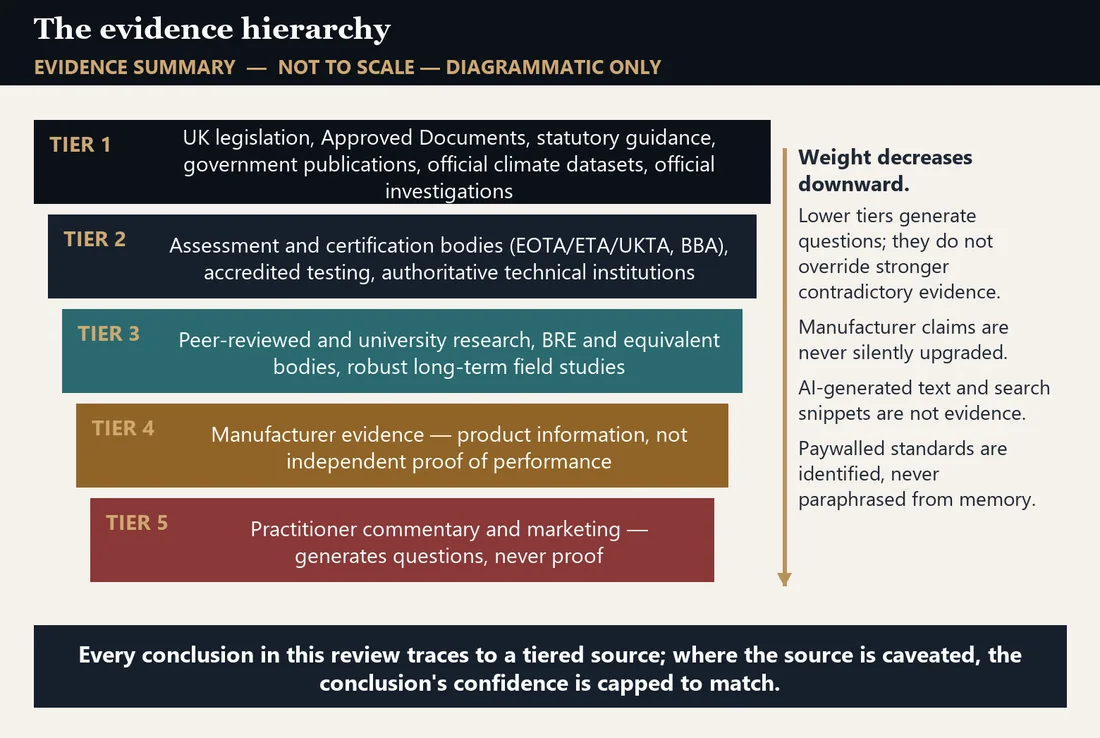
Calibrated language, or it doesn't count.
Every conclusion uses a fixed vocabulary — SUPPORTED, PARTIALLY SUPPORTED, CONTEXT-DEPENDENT, NOT SUPPORTED, CONTRADICTED or INSUFFICIENT EVIDENCE — each with a stated confidence of HIGH, MODERATE, LOW or UNRESOLVED. An honest INSUFFICIENT EVIDENCE is treated as a finding, not a failure: it marks the places where a confident answer would be an unsupported answer. The method also carries a neutrality check — the review could and does support opposite positions in different defined situations, and records that both sides of the industry debate oversimplified, roughly symmetrically.
What the evidence actually establishes
Selected principal findings, carried with the report's own calibrated verdicts. The full set, with sources and confidence reasoning, is in the report.
UK regulation does not require a cavity.
Requirement C2 is functional. Approved Document C guidance admits a solid wall of sufficient thickness, a cavity wall, or an impervious or weather-resisting cladding — its dimensioned cavity provisions are one optional route. The warranty layer imposes dimensioned cavity conditions triggered by framed backing walls, not by cladding type.
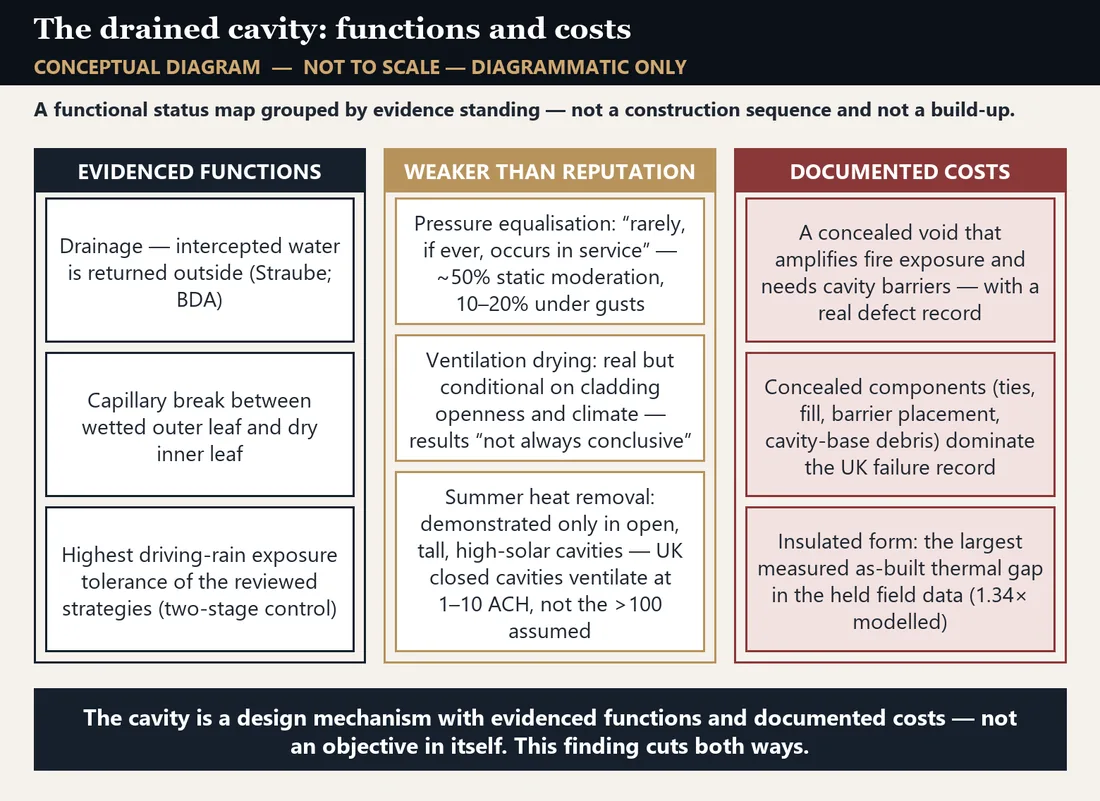
The cavity is a design mechanism, not an objective — and this cuts both ways.
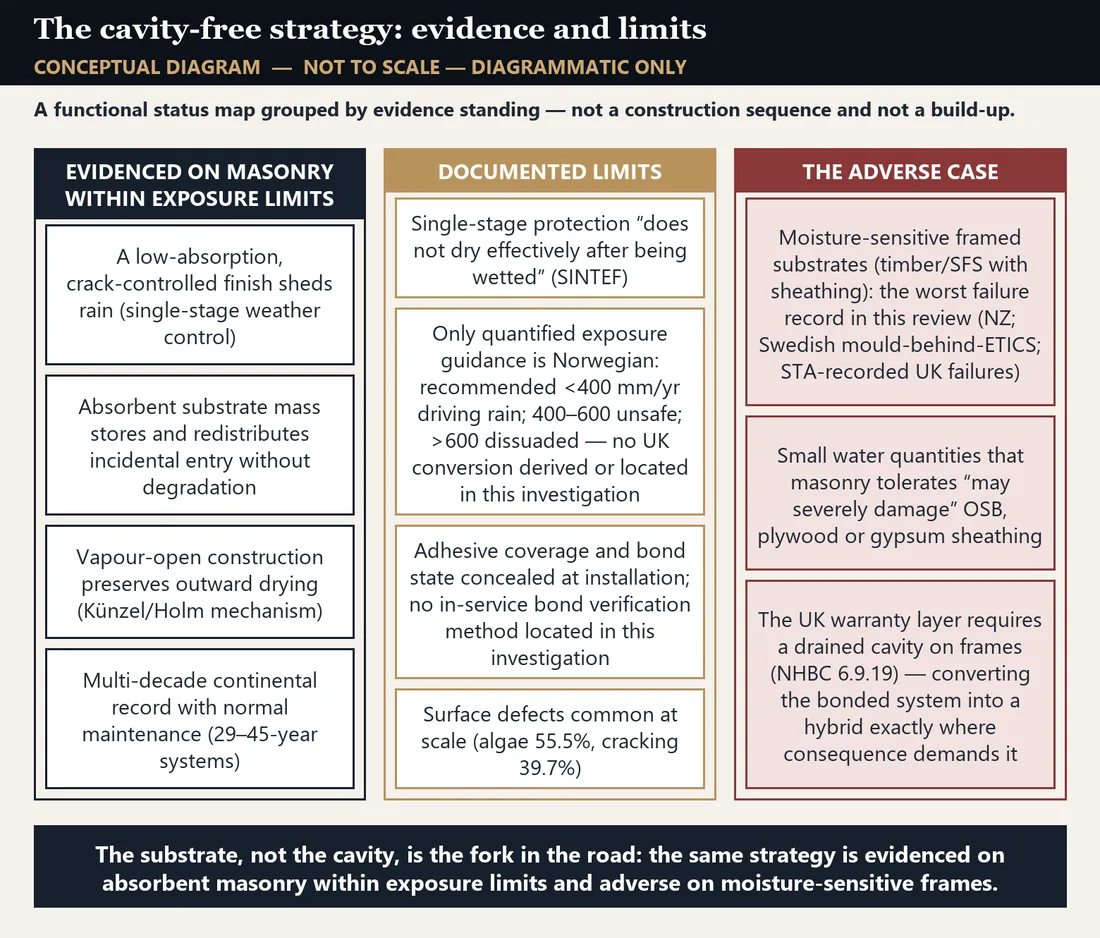
Its evidenced functions are drainage and the capillary break. A bonded system on an absorbent masonry substrate within driving-rain limits has an evidenced alternative second line; the same system on a moisture-sensitive framed substrate is the configuration every examined jurisdiction and the UK warranty layer treats most severely.
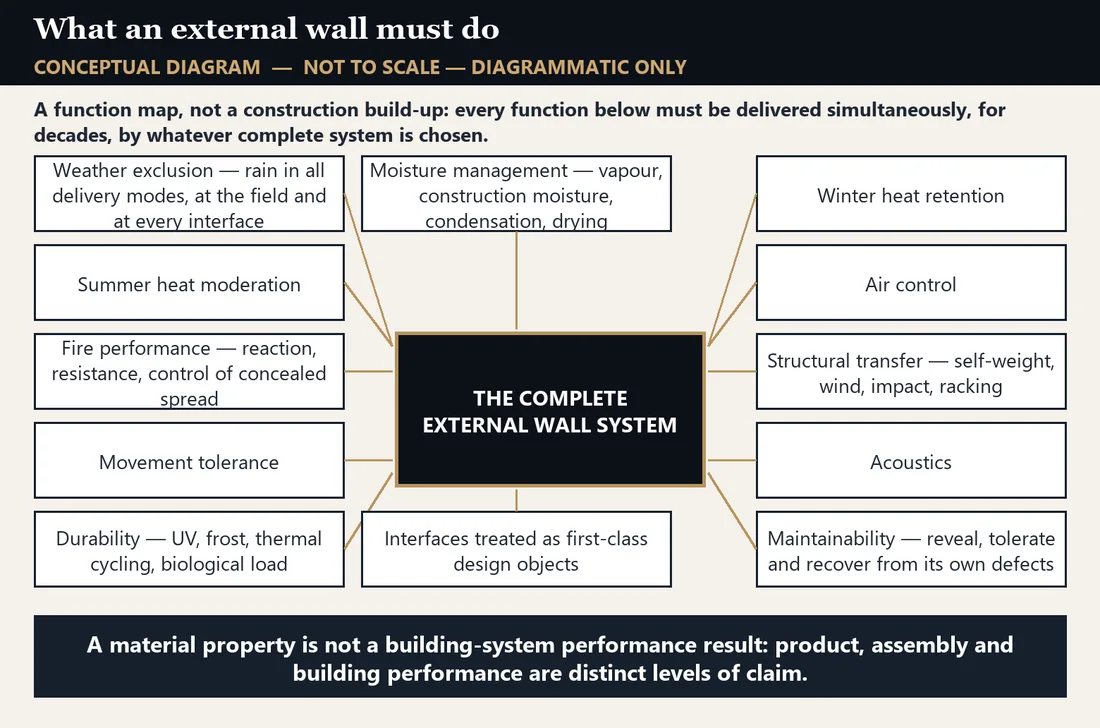
The governing variables are not "cavity or no cavity".
Across moisture, fire, thermal, durability and failure records the deciding variables are: substrate moisture tolerance; driving-rain exposure; what in the wall can burn; interface detailing; and whether the system's concealed functions can be verified.
Fire: a cavity is an exposure amplifier and concealed pathway, not a fuel.
Removing it removes real mechanisms — concealed spread, geometric amplification, barrier dependence — but does not remove fuel, openings as entry routes, or compartmentation duties. Component non-combustibility is a legitimate, lower-risk regulatory route and does not by itself establish system behaviour.
Mould: no causal evidence links wall typology to indoor mould.
The coroner in the Awaab Ishak case expressly found no structural cause; the national statistics contain no cavity-versus-solid breakdown; the analysis that could answer the question has never been constructed. Surface temperature, heating and ventilation govern the condensation limb.
Climate: the adaptation gap in envelope guidance is on the moisture side.
Winter driving rain on exposed orientations is projected to rise 10–25%, while moisture design guidance still rests on 1959–91 exposure data — even as overheating design already uses future weather files.
Neither familiarity nor novelty is evidence.
The traditional record contains concealed wall ties that corroded within 12–26 years; the innovation record contains certificates that "related only to the general suitability of the system". The burden of proof is set by consequence and concealment, not by the age of the technique.
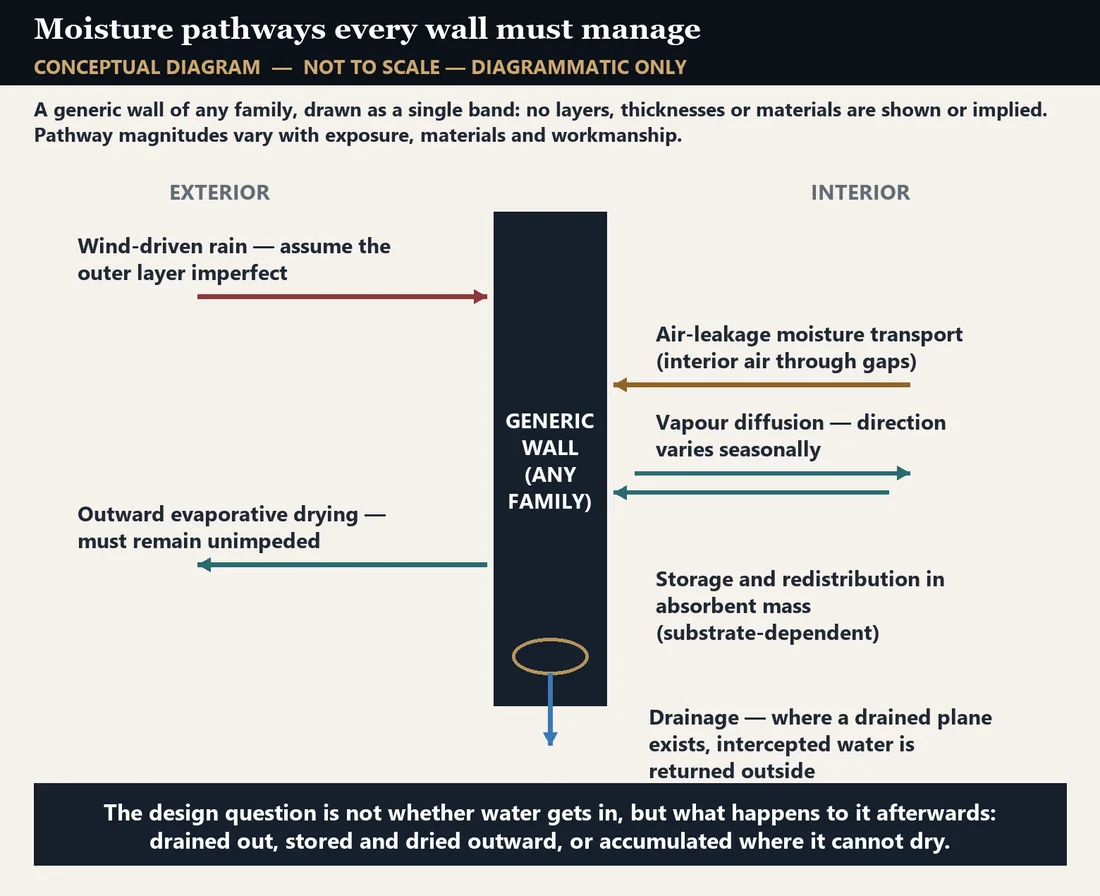
Conditional throughout — and honestly incomplete in places
The fire, moisture, thermal, mould and durability records each dissolve a popular absolute from both sides of the debate; the surviving structure is conditional throughout. And in five areas, the honest verdict remains INSUFFICIENT EVIDENCE:
- Mineral-wool bonded ETICS system fire behaviour
- In-service bond verification for bonded systems
- The mould-typology question — the comparative analysis has never been constructed
- Interface-only drainage equivalence
- UK upland freeze-thaw futures
These are recorded as findings in their own right. Over a 60-year service life, an honest INSUFFICIENT EVIDENCE outperforms a confident unsupported answer.
What this lets a project team actually decide
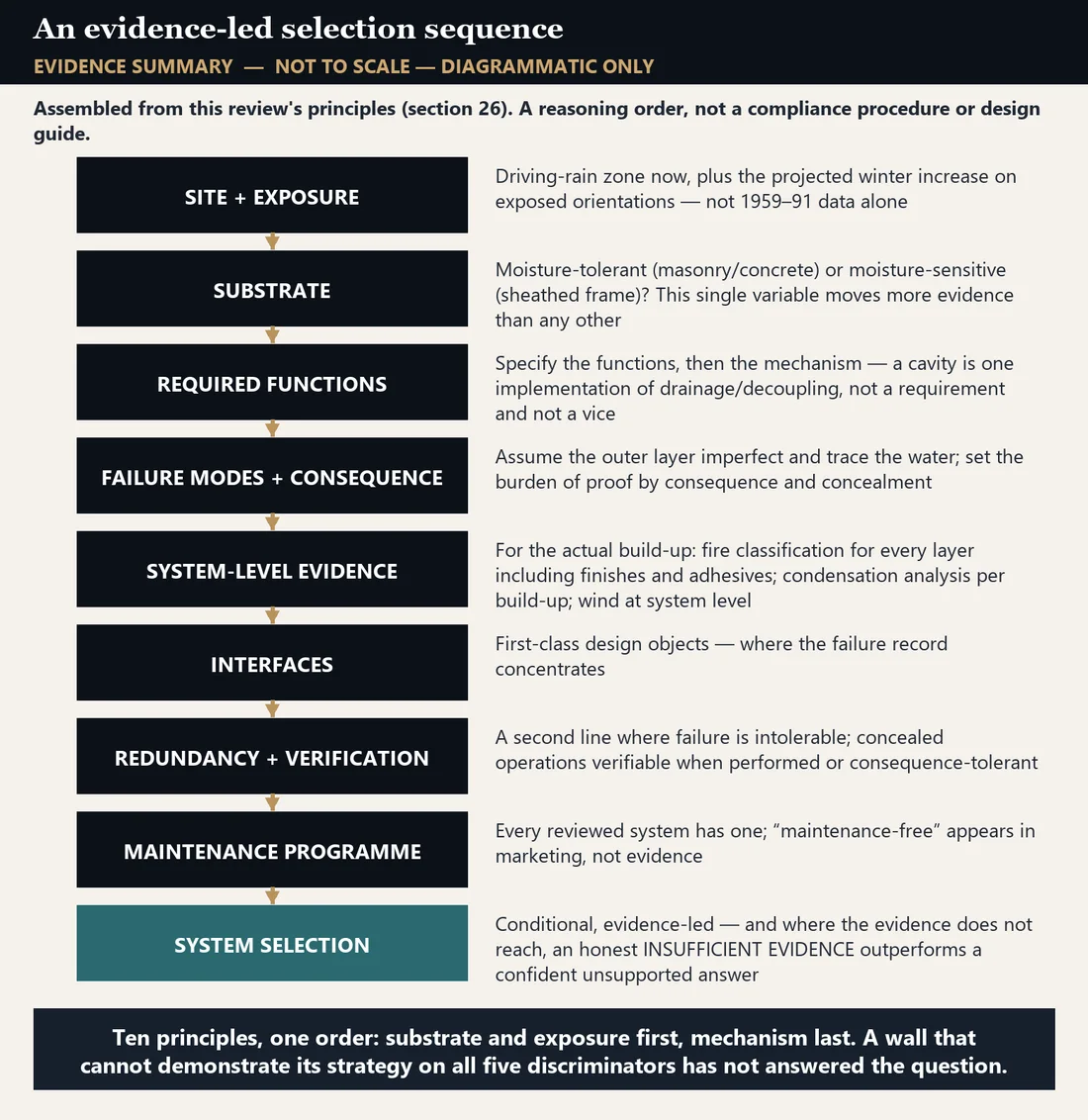
The review closes with conditional conclusions specific enough to act on, and ten principles for evidence-led external wall selection. The decision consequences the evidence supports:
Where a cavity is the supported answer
Moisture-sensitive substrates (timber or steel frame with sheathing); absorptive claddings meeting severe exposure; and wherever consequence-intolerance demands a dimensioned second line. The review would support a cavity being required in such situations.
Where cavity-free is a supported answer
Masonry or concrete substrates within driving-rain limits, with vapour-open systems, system-level evidence and maintained finishes. The review would support omitting the cavity in such situations.
Hybrids
Continuous external insulation with a drained space on frames, and element-level drainage at interfaces, is the direction the warranty layer and the international record already point — with its interface-only form recorded as a genuine research gap, not an established optimum.
The five discriminators
A wall must demonstrate its strategy on the actual substrate, for the actual exposure, at system level, including interfaces, and with a verification story for its concealed functions. A wall that cannot show all five has not answered the question — whether or not it contains a cavity.
Report and technical briefing
The technical briefing film
A 14-minute evidence-led technical briefing of the review — the question, the method and the findings, talked through with the evidence in shot.
External Wall Design in a Changing UK Climate — the full report
The full 43-page evidence review: the complete findings with their sources and confidence reasoning, the thirty propositions tested, the evidence gaps, and the reference appendix.
Where this question shows up in live enquiries
Wrestling with a wall build-up question like this?
Send the question, the build-up and the documents you already have. No charge to submit — we quote before any written work starts.