Fire performancePerformance duties
Fire performance evidence, checked against the actual build-up.
Someone has asked for proof of fire performance — a classification, a test report, a fire resistance period — and the documents you have do not obviously answer the question being asked.
The Bench reviews reaction to fire and fire resistance evidence and explains, in writing, what it supports for the build-up actually proposed — and what it does not.
ScopeEvidence review. Not certification, Building Control or design sign-off.
The questions that arrive with a fire query
Does this classification apply here?
A product or system holds a reaction to fire or fire resistance classification, and someone wants confirmation that it covers the proposed use, thickness and substrate.
Is this test report enough?
A test report exists, but Building Control, an engineer or a client is asking whether it actually covers the build-up on the drawing.
Is this product evidence or system evidence?
The documents relate to a product on its own, but the question being asked is about a complete system or build-up.
Tested build-up versus proposed build-up
The tested configuration and the proposed configuration differ — in layers, fixings, cavities, thickness or supporting construction — and someone has noticed.
The paperwork behind a fire performance question
Every enquiry is different, and you do not need a complete set before getting in touch — send what you have. These are the documents that usually matter:
- Classification reports for reaction to fire or fire resistance
- The test reports sitting behind the classification
- Field of application or extended application documents
- Product data sheets and declarations of performance
- Drawings or details of the proposed build-up
- The question as raised — the email or comment from Building Control, the engineer or the client
Where fire evidence falls short
The classification covers the product, not the build-up
The evidence relates to a board or product in isolation, while the question is about the wall, floor or system it sits in.
The field of application is narrower than assumed
The proposed substrate, thickness, orientation or fixing method falls outside the scope the test or assessment actually covers.
A data sheet claim stands in for test evidence
A headline figure from marketing literature is being quoted where a test report or classification is what the question needs.
The tested and proposed build-ups quietly differ
One changed layer, cavity or fixing detail can mean the evidence no longer reads across to the project.
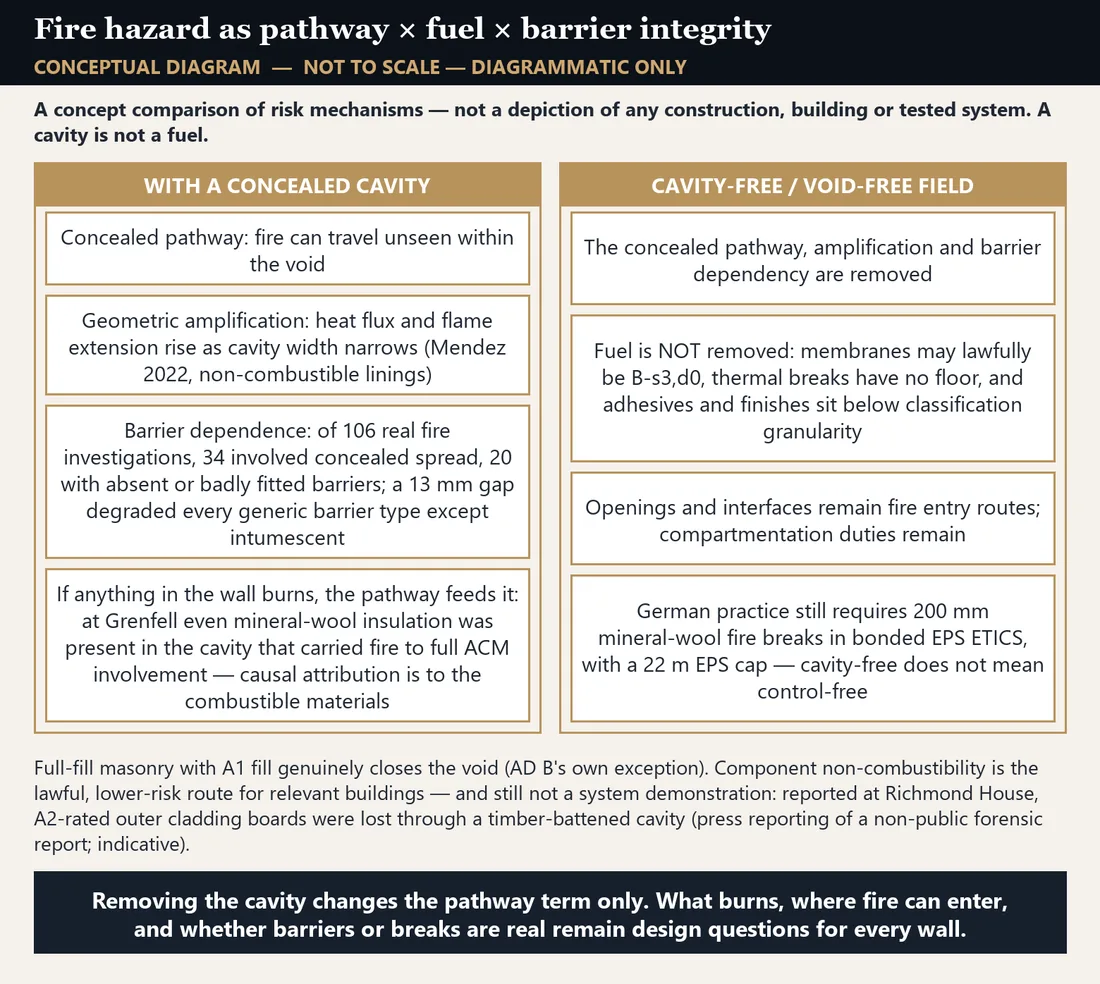
Where fire travels in an external wall
A conceptual figure from the published review. It compares fire pathways in principle; it is not a fire strategy or test evidence for any build-up.
Fig. 1Cavity vs No Cavity? · External Issue 02 · August 2026 · conceptual figure
A written fire evidence position you can use
The Bench reviews the fire evidence you have against the question actually being asked, and puts the position in writing.
- Review classifications, test reports and field of application documents against the proposed build-up
- Separate product evidence from system evidence and identify which one the question needs
- Set out where the tested and proposed build-ups match, partially match or differ
- List the gaps — missing, unclear or non-matching evidence — so they can be resolved
- Provide a written note you can put in front of Building Control, an engineer or the project team
The output is written — a review note, clarification note, gap register or evidence summary you can use with the project team. We quote before any written work starts.
Clear about the limits of the review
The Bench reviews evidence and gives written guidance. For fire performance in particular, the limits matter:
Not part of the review
- Fire engineering judgement, fire strategy approval or acceptance of fire risk
- Certification, testing or product approval
- Building Control or other statutory sign-off
- Design responsibility for the build-up or detail
Those decisions stay with the competent person or organisation appointed on the project. Our written review supports them; it does not replace them.
Fire evidence question holding up the job?
Send the question, the build-up detail and the documents you already have. No charge to submit an enquiry — we quote before any written work starts.
Not sure where your question sits? Find your route ›
What helps us start
- The question, as it was put to you
- What the product or build-up is, and where it is going
- The documents you already have — data sheets, reports, certificates, drawings
- Any comment from Building Control, the designer or the client
- When you need an answer
You do not need a complete set to get in touch — send what you have.